
I was shocked to find out that English has three different verbs for what Spanish expresses with just one: esperar.
At first, how can that be possible?
In Spanish, esperar always means the same thing. But in English, we distinguish between:
- hope (with your heart),
- expect (with your mind),
- and wait (with your body).
Once I understood this, everything changed. I could use them correctly because they made sense to me.
Interestingly, something similar happens with ser and estar. Once you understand how they work, you’ll be able to incorporate them correctly in your daily conversations.
The Problem with «permanent vs temporary».
The common explanation says ser is for permanent things and estar is for temporary ones.
But this doesn’t always work.
Does ser have to do with permanent things?
Look at the examples in the chart! Are they permanent or temporary situations? ¿Son permanentes o temporales?
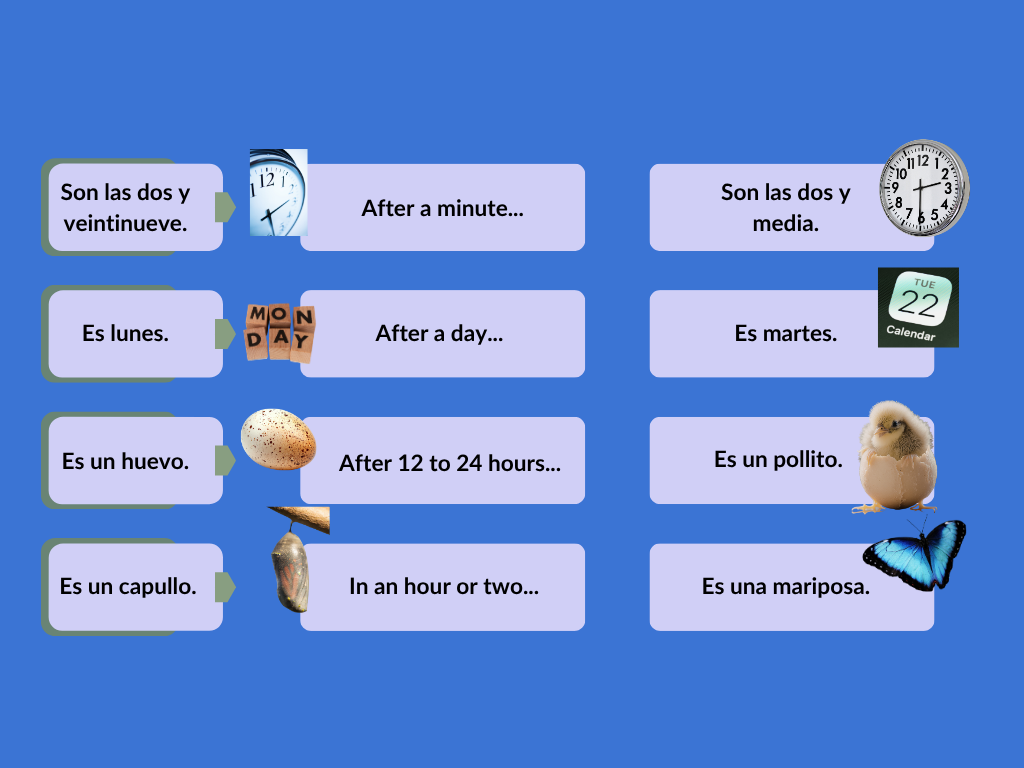
Surprisingly, all the situations above are temporary. So why the verb ser?
Let’s go deep into it! Pay attention to the first and second examples. Son las dos y veintinueve; son las dos y media, es lunes, es martes, etc. Even though time is shifting constantly, Spanish speakers use ser. Why? Because time is a human invention. We measure the time in seconds, minutes, hours, days, weeks, months, and years. So that is what it is: minutes, hours, days, months, years, etc. are the essence of time.
And what about the third and fourth examples? A caterpillar emerges in one or two hours, while a chicken hatches in less than a day. Still, we use ser, even though two changes happen in a short time.
So, if ser isn’t about permanence, what are speakers actually trying to convey?
Let’s look for an answer through this picture! Can you see the same as I can?
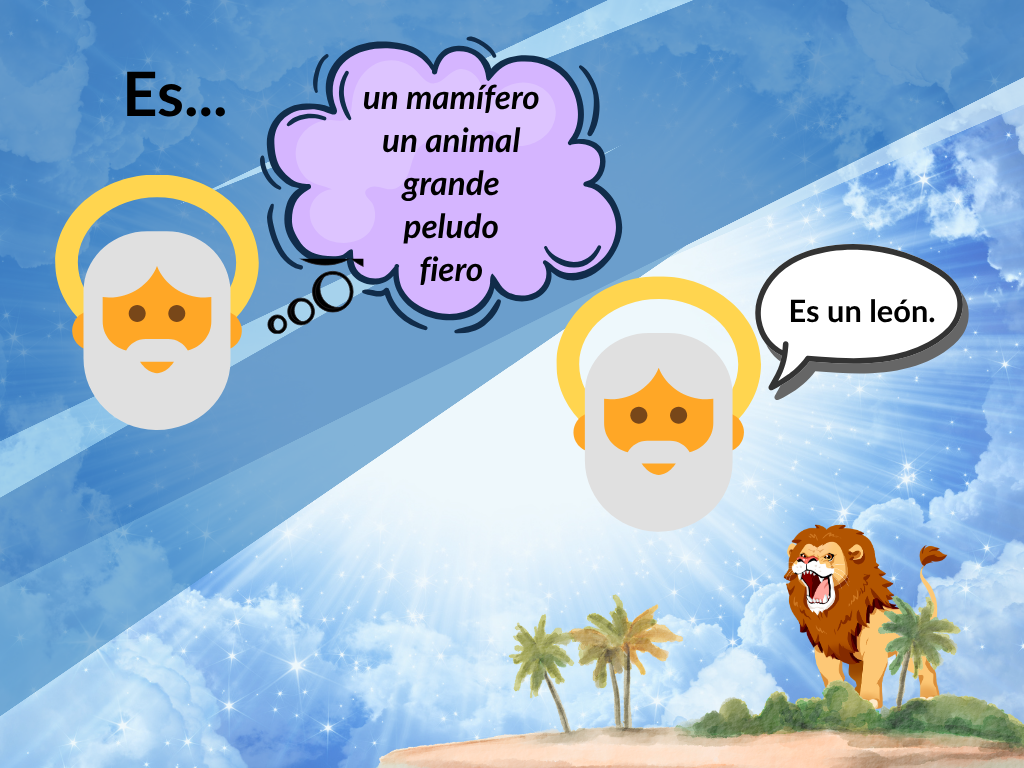
At the deepest level, before anything is named, we already understand what it is. Ser tells us what something is.
In other words, when Spanish speakers use ser, they are identifying the inherent characteristics, essence, or identity of a subject.
Does «estar» have to do with temporary things?
Do Spanish speakers use estar for temporary situations?
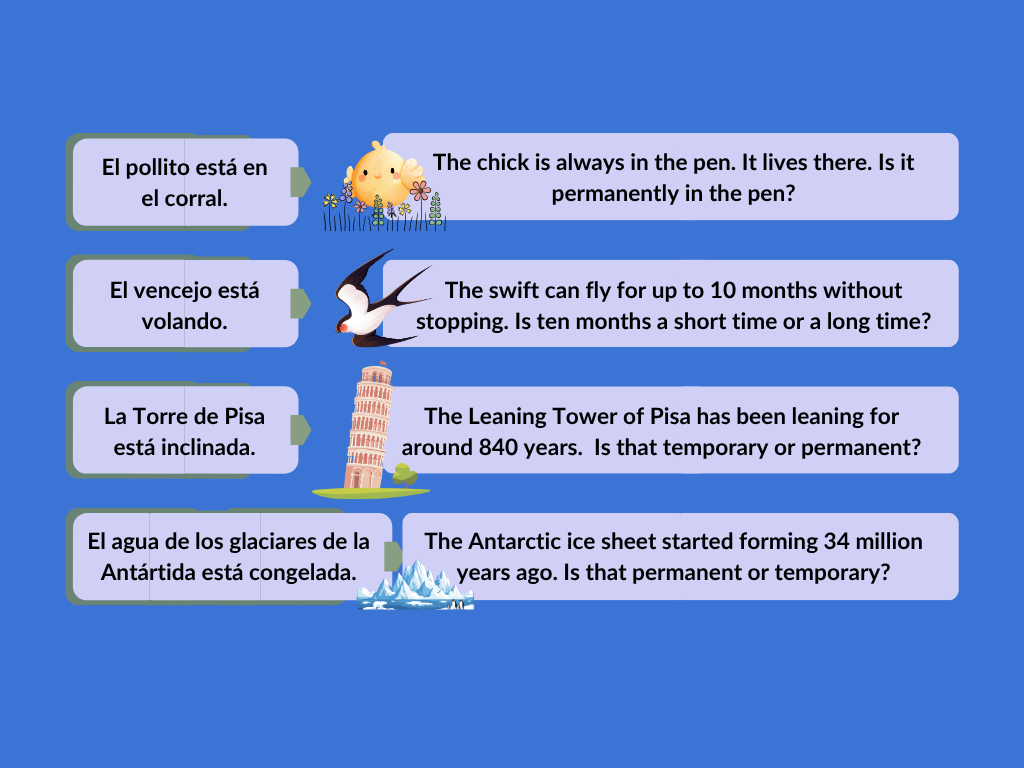
At first glance, these examples may seem straightforward. But once you look a little closer, they raise an interesting question: if something lasts a long time, does that always mean we should use ser? Not necessarily. Some cases are permanent, others are simply long-lasting, and others depend on how we view the situation. Let’s take a closer look.
A chick may stay in the same pen for its whole life. A swift can fly for months without stopping. The Leaning Tower of Pisa has been leaning for centuries. And what about the Antarctic ice sheet?
Before you jump to conclusions, take a look at the chart below. It may surprise you.
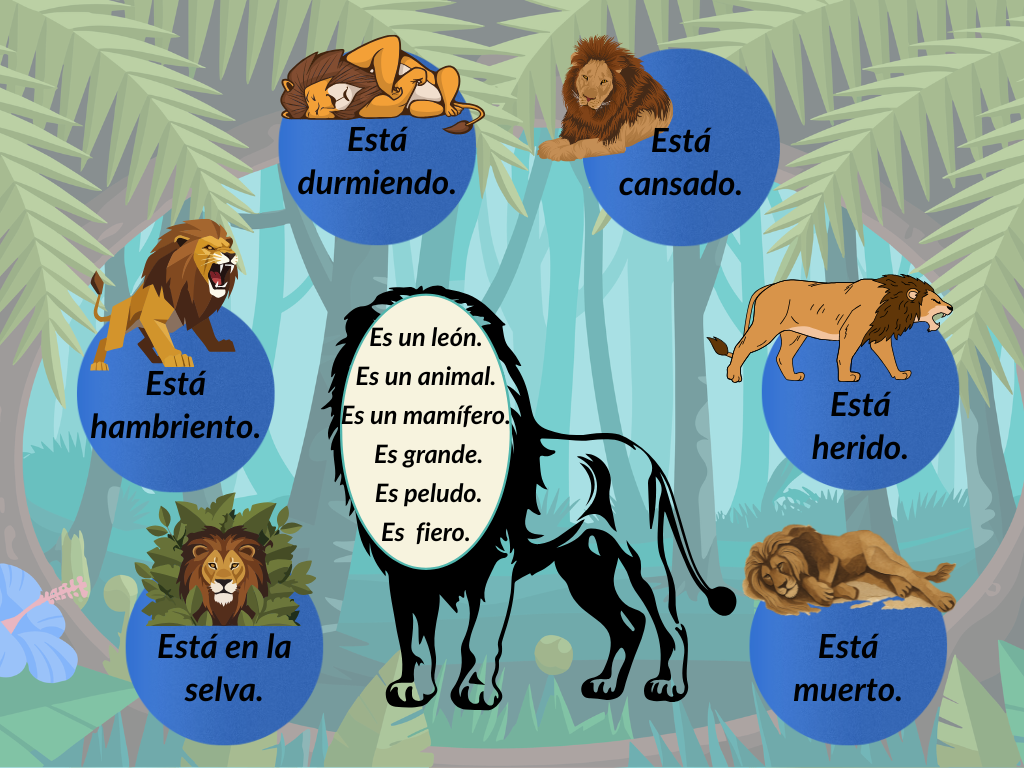
When you talk about what a lion looks like, you use the verb ser to describe its inherent characteristics, what makes it the being it is, its essence, the way anyone can recognize it. What would I say to someone who has never seen a lion?
When you express different situations a lion can experience or get through, you use the verb estar. This conclusion explains perfectly well why we use estar to refer to death as a permanent state.
Therefore, when Spanish speakers use estar, they are describing circumstances, states, or conditions.
How does English distinguish between ‘ser’ and ‘estar’?
Lexical Differentiation (Using Different Words):
- Characteristic: He’s smart (Es listo).
- State: He’s ready (Está listo).
- Characteristic: Is this street safe? (¿Esta calle es segura?).
- State: Are you sure? (¿Estás segura’)
Grammatical Structures (The «-ing» Factor)
- Characteristic: She’s rude (Ella es grosera).
- Condition: She’s being rude (Ella está grosera. Se está comportando de forma grosera).
The Use of «Like» vs. «How»
- Asking for essence: What is she like? (¿Cómo es?)
- Asking for state: How is she? (¿Cómo está?)
The «-ing» vs. «-ed» Adjective Distinction
- Ending -ing adjectives describe the essence: The movie is boring (La película es aburrida).
- Ending -ed adjectives describe a state, a condition, or how a person feels as a result of something: I’m bored (Estoy aburrido).
So what’s the real difference?
The difference between ser and estar is not about permanence or temporality.
Rather, it’s about how Spanish speakers see reality.
To wrap things up, let’s move beyond the ‘permanent vs. temporary’ trap. To understand a speaker’s true intent, simply associate each verb with these core concepts:
| SER | CHARACTERISTICS | WE REFER TO THE ES-SENCE |
| ESTAR | CIRCUMSTANCES | WE REFER TO E-STATES) |
When you start seeing the language this way, your confidence grows naturally because things finally make sense!
Feel more confident in every Spanish conversation. Join my newsletter for weekly, practical tips on mastering ser, estar, and more.